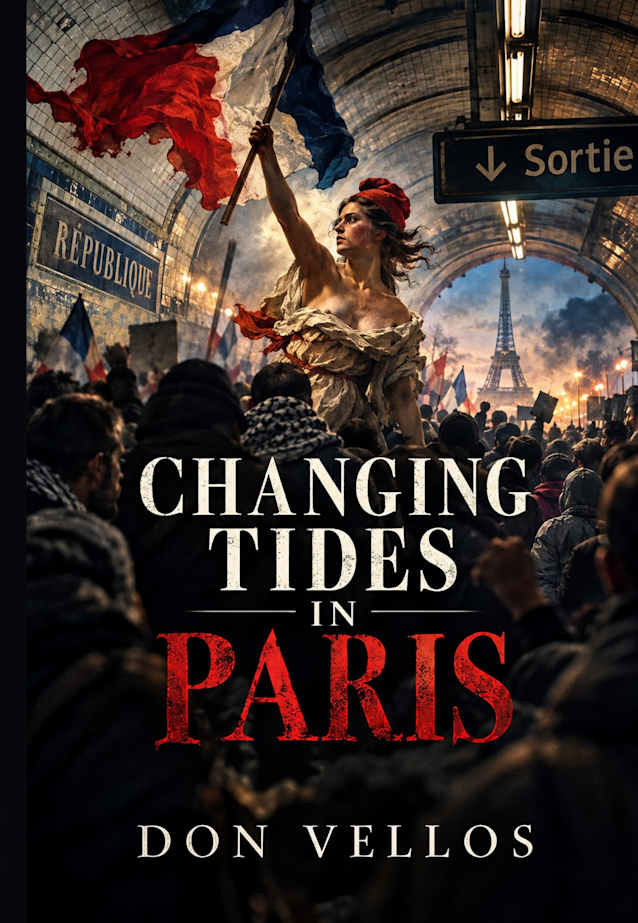
CHANGING TIDES IN PARIS
About
Changing Tides in Paris is a 55,000-word political thriller about a clandestine organisation attempting to engineer a revolution in France—and the people who discover that a revolution, once set in motion, may become impossible to control.
Bekhan Gada, a young Chechen prisoner, is given an impossible choice: die, or accept a new identity. He becomes Umayyah Chebel, is transported to Algeria, and subjected to an extraordinary programme of religious, technological, physical and military training. His handlers are building a weapon in human form. Yet the conditioning is complicated by his growing attachment to Amira, a young woman whose compassion repeatedly reminds him that he is still human.
After marrying Amira, Umayyah is sent to France, where the organisation’s ambitions become far larger. In the Paris suburb of La Grande Borne, he and Amira build a powerful criminal network, initially through the drug trade. Violence, money and organisation gradually transform a local gang into something resembling a political movement. Umayyah’s public reputation grows, while behind the scenes a mysterious figure known only as U begins sending increasingly provocative messages.
Meanwhile, Detective Roger Bireau begins investigating apparently unrelated clues: an illegal cannabis plantation in Brittany, sophisticated surveillance equipment, a distinctive Arabic symbol and crack cocaine distributed in professionally branded packets. His investigation gradually reveals that the criminal network is connected to a much larger project. The police are not simply confronting organised crime; they are approaching the edge of a political conspiracy.
The central architect of the next stage is Khalid Abdullah, an experienced strategist recruited for a single purpose: to make a revolution possible. His insight is that France cannot be defeated by force alone. The organisation must first understand public frustration, exploit divisions and persuade ordinary citizens that change is both necessary and possible. Their objective is to turn social dissatisfaction into a mass movement capable of overwhelming the institutions of the French Republic.
As the conspiracy develops, international forces enter the picture. Russia, clandestine operatives, criminal networks, political movements and intelligence services become entangled in a rapidly escalating chain of events. Detective Bireau comes closer to understanding the design, but the evidence remains fragmented and the authorities repeatedly underestimate the scale of the threat.
By July 14, France is approaching a point of rupture. A carefully engineered sequence of protests, political tensions, criminal activity and public anger converges in Paris on Bastille Day. The government believes it is prepared for disorder. It is not prepared for a movement designed to make disorder appear spontaneous.
Changing Tides in Paris ultimately asks whether political power can be manufactured from fear, grievance and hope—and whether those who believe they are controlling history can survive the moment when history begins controlling them.